As a future nurse, the increasing knowledge of how a virus works in the human body continues to fascinate me. Viruses are a relatively new discovery, and are continuously being explored. We are always hearing about the human microbiome, but here is also what is being said about the human virome.
One of the human microbiomes is its Virome #GMFH2014
— GutMicrobiota Health (@GMFHx) March 8, 2014
First A Brief History
As I have said before, the virus is a relatively new discovery. It was only about 100 years ago that scientists could not even fathom a microbe that was smaller than a cell, or basically particles. They had thought of the the infectious agent as a contagious fluid and called it contagium vivum fludium. The word virus is actually a Latin term for poison, which scientists began to use about the 1930s to describe this fluid. It was not until 1935 when an American scientist, Wendell Stanley, was able to isolate the tobacco mosaic virus, and was able to study the chemical and structural components of the virus. Around the same time, the electron microscope was invented, and the virus was able to be seen for the first time (Tortora, Funke, & Case, 2013.)
Are Viruses Living Things?
Whether viruses are living things are a very difficult topic to discuss. "Life can be defined as a complex set of processes resulting from the actions of proteins specified by nucleic acids, " (Tortora, Funke, & Case, 2013, p. 370.) This means that in living cells, the actions of nucleic acid are in action all the time, and as this action is halted in viruses when they are not in living host cells, they cannot be considered a living thing. At the same time, when a virus is in a host's cells, the nucleic acids are active, and then viruses can be considered a living thing. When a virus comes alive, as a future nurse, I will have to consider a virus as a living thing, just as I would consider pathogenic bacteria, protozoa, and fungi (Tortora, Funke, & Case, 2013.)
The Structure of the Virus
The virus is a very basic structure. A viron, or a fully developed infectious viral particle, is composed of nucleic Acid and a protein coat when outside of the host cell. Figure 1 shows the basic structure of a virus, but keep in mind, like other microorganisms, viruses can also have many different shapes(Tortora, Funke, & Case.)
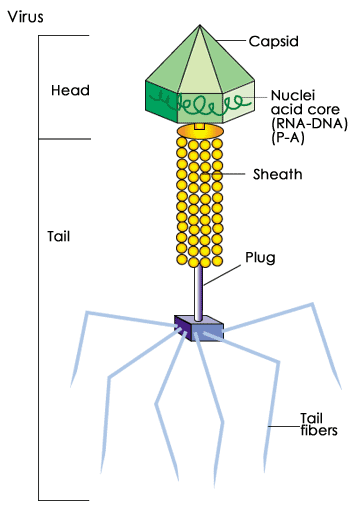
figure 1. The basic structure of a virus (Spark Notes, 2014)
The structures I want to point out are the nucleic acid and the capsid.
The nucleic acid can use either DNA or RNA for their primary genetic material, but they can never have both. This is very different from prokaryotic and eukaryotic cells, as they use DNA as their primary genetic material and RNA has an auxilliary role (Tortora, Funke, & Case, 2013.)
The capsid is a protein coat that covers the nucleic acid. This is also the structure that accounts for most of the mass for the virus. The capsod could also be covered by an envelope which usually consists of lipids, proteins, and carbohydrates. The envelope is developed when animal viruses are released from the host cell, and is formed from the the cell's plasma membrane (Tortora, Funke, & Case, 2013.)
The Human Virome
The interaction between humans and virus are still being studied. The human virome is the collection of viruses that are in or on humans.

Figure 2. (Wylie, Weinstock, Storch, 2012)
Figure 2 shows the components of the human virome. They range from the viruses that we know that cause deadly diseases, or persistent viral diseases, to retroviruses, which have shown to be associated with certain diseases, but have not yet been shown to causal. Retroviruses are actually present ubiquitously, or ominously present, in tissues and represent 8% of the human virome. Bacteriophages are important, because they influence the population of bacteria, as well as the virulence of the bacteria (Wylie, Weinstock, Storch, 2012.)
Now online: Lecuit and Eloit discuss the human virome and its role in health http://t.co/rprkbWPL8r
— Trends Microbiol (@TrendsMicrobiol) July 31, 2013
Societal Impact
Now we need to consider the impacts this discovery will have on society, and the most obvious thing is the way we learn about how to prevent these viruses. The HPV or human papillomavirus was the most popular virus that medicine have began to use.
This vaccine though continues to stir debates on their benifits:
This vaccine though continues to stir debates on their benifits:
RT @nytimeshealth: #HPV Vaccine Found to Help With Cancers of Throat http://t.co/j3RcPkDpeC #Guardasil
— Pure Essence Labs (@PureEssenceLabs) July 20, 2013
As many know the Guardasil shot is advertised to decrease the risk of cervical concer, but immunizing the virus that has been linked to the increased risk, HPV. They have begun to see a decrease in other types of cancers that they are believing that there is a better reason to obtain this immunization.
We talked about the the dangers of Guardasil Vaccine and now the Japanese government has taken the right decision... http://t.co/2hUjnKfGYU
— Nature's Wonders (@natureswonders2) June 16, 2013
Japan though has limited the HPV vaccines due to adverse reactions. As only recently has the vaccine been given to the population, they are still continuously seeing what kinds of responses the human body has because of this immunization, and the human response is what as a future nurse I will have to treat.
Conclusion
As we are only beginning to understand viruses, this understanding has given us so many benefits in our lives. We continue to try and fight viruses, and eventually with the increases in scientific technology, we will completely understand them.
References
